Software Architecture & System Integration – Connecting Firmware, Cloud, PC, and AI
Modern systems span embedded hardware, PC backends, cloud platforms, and increasingly – local AI agents. My approach centers on system architecture design as the foundational discipline: defining clean data flows, modular layers, and scalable communication patterns from the first line of architecture documentation through to production deployment.

Architecture-First Design Philosophy
Every successful integration starts with a clear architectural blueprint. I design layered system diagrams that separate concerns into:
- Hardware Abstraction Layer (HAL) – sensor/MCU drivers, pin mapping, interrupt routing
- Communication Stack – protocol definitions for UART, SPI, I2C, USB, Ethernet, and wireless links
- Application Logic – state machines, data processing pipelines, real-time control loops
- Cloud & AI Interfaces – telemetry ingestion, OTA update orchestrators, and LLM agent endpoints This layered approach eliminates bottlenecks early, reduces power consumption, and ensures real-time responsiveness from day one.
AI & LLM Integration – My Specialist Domain
As a specialist in OpenClaw, Ollama, embeddings and LLM integration, I bridge traditional embedded/PC/cloud systems with local and hybrid AI agents:
| Capability | Description |
|---|---|
| Ollama | Deploy and serve local LLMs (Llama, Qwen, Mistral) on edge devices and PC backends – no cloud dependency |
| Embeddings | Build semantic search and RAG pipelines using vector databases (Chroma, FAISS) connected to your sensor or log data |
| OpenClaw | Integrate claw-controlled or robotic manipulation systems with LLM reasoning for autonomous operation |
| LLM Agents | Create AI agents that query your device telemetry, generate reports, and trigger maintenance workflows |
My architecture diagrams explicitly model how LLM inference pipelines sit alongside MCU firmware and cloud endpoints – ensuring latency, privacy, and data sovereignty requirements are met.
Interface Definition (UART, SPI, I2C, USB, Ethernet)
Clear interface specifications prevent integration failures at every level. I define and implement communication protocols with full documentation:
- Timing diagrams & voltage-level constraints
- Error-handling routines & retry strategies
- Protocol conformance checks for industrial/medical compliance
Hardware-Software Co-Design
System architecture is not purely digital. I work at the hardware–software boundary, co-designing PCB layouts with firmware logic. Key activities include:
- Pin mapping & GPIO optimization
- Interrupt routing & DMA channel allocation
- Memory partitioning for real-time performance
- Power budget analysis & low-power mode integration
Prototyping & Proof-of-Concept
Before committing to mass production, I build functional prototypes that validate the system architecture under real-world load. Using development boards, logic analyzers, oscilloscopes, and local LLM inference environments, I test hardware–software–AI interaction early – de-risking your timeline and budget.
Validation & Verification
Comprehensive testing is critical for industrial, medical, and AI-driven applications. I perform:
- Unit & integration tests across all layers (HAL, stack, app, AI)
- System-level stress tests with long-duration stability runs
- Boundary scanning & protocol conformance checks
- LLM output validation – ensuring consistency, format compliance, and latency targets
Let’s Build Your System Architecture
Integrating embedded hardware with PC software, cloud services, and local AI requires deep cross-domain expertise. With proven experience in real-time systems, IoT security, and LLM deployment, I deliver turnkey system integration that gets your product to market faster, with higher quality, and with AI capabilities embedded from the start.
Connectivity & Cloud (IoT Gateways, MQTT, OTA)
Modern embedded systems are increasingly defined by their ability to connect, communicate, and collaborate. Whether you are building a smart building sensor network, an industrial predictive maintenance system, or a fleet of agricultural IoT devices, the bridge between your hardware and the cloud is critical. Poor connectivity design leads to data loss, security vulnerabilities, and costly field updates.
I specialize in building secure, scalable, and maintainable IoT architectures from the sensor node to the cloud dashboard.
IoT Gateway Development
The gateway is the nerve center of any IoT deployment. It aggregates sensor data, manages local processing, and relays information to the cloud. I develop gateways on platforms like ESP32, STM32/NXP with Wi-Fi/Bluetooth modules, Raspberry Pi, and Linux-based SoCs.
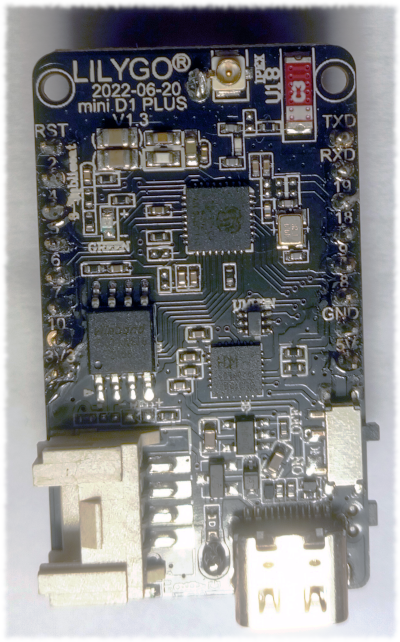
ESP32 LilyGO – Ideal for IoT gateway prototyping with WiFi, Bluetooth and LoRa.
Key features I implement:
- Protocol translation — bridging Zigbee, Z-Wave, Modbus, or CAN to MQTT/HTTP.
- Edge processing — filtering and aggregating data locally to reduce cloud costs.
- Offline buffering — storing data locally when connectivity drops and syncing on reconnection.
Cloud Integration (On-Premise, AWS IoT, Azure IoT, Google Cloud IoT)
Connecting your device to a cloud platform unlocks remote monitoring, analytics, and device management. I have hands-on experience with:
- MQTT/REST/GraphQL APIs — On-Premise, everything under your full control.
- AWS IoT Core — device shadows, MQTT topics, and IoT rules for data routing.
- Azure IoT Hub — device twins, direct methods, and automatic device provisioning.
- Google Cloud IoT Core — MQTT bridge, device registry, and Cloud Pub/Sub integration.
Every integration includes retry logic, exponential backoff, and connection health monitoring to ensure robust operation under real-world network conditions.
Secure Data Transmission (TLS/SSL)
Security is not an afterthought in IoT — it is a fundamental requirement. I implement:
- TLS 1.2/1.3 for all device communication.
- TLS performance optimization e.g. boosting TLS hardware acceleration for XMC7200 with +33 % faster than the Infineon library with full compatibility — documented write-up on the Infineon developer community.
- Certificate-based authentication using X.509 certificates or pre-shared keys (PSK).
- Secure boot and firmware signing to prevent unauthorized code execution.
- Encrypted storage for secrets, keys, and configuration data on the device.
I also conduct threat modeling sessions early in the design phase to identify and mitigate attack vectors before they reach production. The performance losses on the crypto path are detailed separately: XMC7200 TLS performance.
Over-the-Air (OTA) Updates
Field devices must be updatable. OTA updates allow you to fix bugs, patch vulnerabilities, and add features without physical access. I design OTA pipelines that include:
- Delta updates — transmitting only changed binaries to minimize bandwidth usage.
- Rollback protection — keeping the previous firmware version for safe fallback.
- Staged rollouts — updating devices in batches to catch issues early.
- Integrity verification — SHA-256 checksums and cryptographic signatures on every update package.
Data Visualization & Dashboards
Raw sensor data is useless without actionable insights. I build dashboards and visualization layers using:
- Grafana with InfluxDB or Prometheus for time-series monitoring.
- Node-RED for rapid prototyping of data flows and low-code dashboards.
- Custom web frontends (React, Vue.js) for branded user interfaces.
- Real-time WebSocket feeds for live sensor updates.
Each dashboard is tailored to your domain — whether that means temperature trends for cold chain logistics or motor vibration analysis for predictive maintenance.
Let Us Connect Your Devices
From a single prototype to a thousand-device deployment, I deliver end-to-end IoT connectivity with production-ready code and support in English, Italian, or German.
How this fits with the rest of the system
Architecture is the layer that decides how firmware and connectivity behave under real load — see Firmware & Driver Development. If your project spans architecture, firmware, and connectivity, contact me.
Architecture work is remote-friendly: diagrams, interface definitions, and test suites do not need physical access to your hardware. Hardware validation is scheduled in blocks.
 Telegram
 LinkedIn
 X (Twitter)
 Facebook
 VKontakte
 Whatsapp